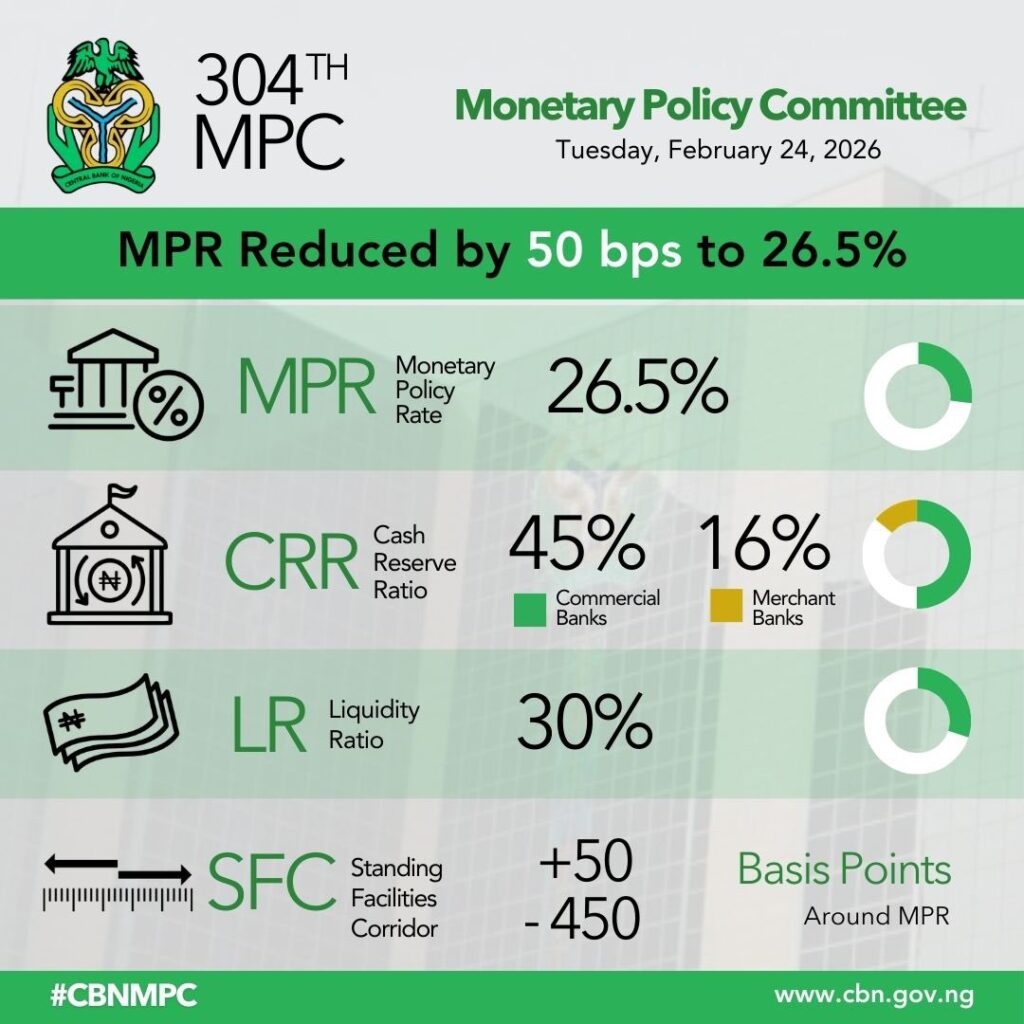



The Central Bank of Nigeria (CBN) on Tuesday reduced its interest rate by 50 basis points to 26.5%, in line with its monetary policy stance to stabilise inflation while supporting economic growth, news.ng reports.
This was disclosed in a communiqué issued after the 304th meeting of the Monetary Policy Committee (MPC), as members opted to lower the Monetary Policy Rate (MPR) from 27% to 26.5%.
Economically, the MPR serves as the CBN’s benchmark interest rate, which affects lending rates across the country’s banking sector. This reduction is expected to cushion borrowing costs, aid investment, and support economic activity.
According to the communiqué, the MPR was the only component adjusted, leaving other monetary parameters unchanged.
For instance, the Cash Reserve Ratio (CRR) was retained at 45% for commercial banks and 16% for merchant banks.
Similarly, the Liquidity Ratio remained unchanged at 30%. This means banks will continue to maintain at least 30% of their total deposits in liquid assets to boost financial stability.
Furthermore, the MPC retained the Standing Facilities Corridor at +50 and -450 basis points around the MPR. This allows banks to either borrow from or deposit funds with the apex bank, helping to stabilise short-term interest rates in the money market.
The 50-basis-point reduction is seen as a sign of an easing cycle; however, this will depend largely on the pattern of inflation, exchange rate movements, and the broader macroeconomic climate going forward.
According to the communiqué, “in reaching this policy decision, the Committee took into account the sustained deceleration in year-on-year headline inflation in January 2026, marking the eleventh consecutive month of decline. This downward trajectory in inflation was driven mainly by the continued effects of the contractionary monetary policy, stability in the foreign exchange market, robust capital inflows, and improvement in the balance of payments.
“The momentum was further reinforced by relative stability in the prices of petroleum products and improved food supply conditions, especially staples. These outcomes have indicated that prior tightening has continued to anchor expectations.
“The MPC particularly noted the remarkable performance of Nigeria’s external sector, evidenced by the robust accretion to foreign exchange reserves, supported by higher export
earnings and increased remittance inflows. This has contributed to greater stability in the foreign exchange market and bolstered investor confidence.
“Members also welcomed the newly issued Presidential Executive Order 09, which redirects oil and gas revenues into the Federation Account. The Committee acknowledged the potential impact of this Order in improving fiscal revenue and accretion to reserves.”