

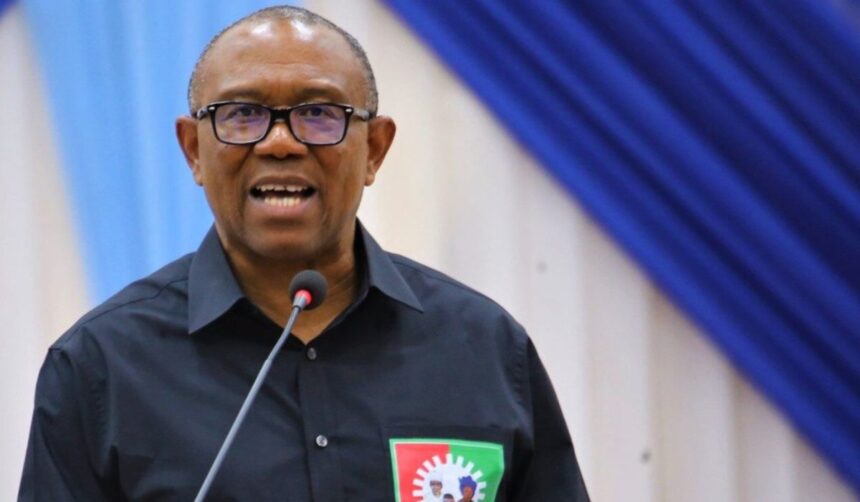
Former Labour Party presidential candidate Peter Obi has intensified his criticism of Nigeria’s political system, describing the country as a “crime scene” and calling for stringent measures to address certificate forgery ahead of the 2027 general elections.
In a post on X Monday, Obi lamented the proliferation of dishonest individuals in leadership positions and questioned how young Nigerians can be expected to uphold integrity when those in power engage in criminal practices.
“Whenever I talk about Nigeria being a crime scene, those who are part of the criminality and their hirelings will quickly start their noise-making, attacking and blackmailing me. But how do you tell people that those whose integrity, character and behaviour are supposed to be exemplary and emulated in society have become the very source of the nation’s decay? How do you tell young Nigerians to be honest and upright when those they are supposed to emulate are the least to be emulated because they are criminals and dishonest?” Obi stated.
The former Anambra State governor emphasized that certificate forgery constitutes a grave criminal offense globally and should be treated with corresponding severity in Nigeria.
“Certificate forgery is a serious criminal offence in all countries of the world. It is one of the most corrupt practices heavily punished,” he declared.
Drawing from his recent international engagements, Obi recounted his experience during a visit to Indonesia earlier in the year, where he engaged with high-ranking government officials and electoral authorities.
“In one of my knowledge-seeking visits to Indonesia early this year, after interacting with several ministers responsible for Health, Villages, SMEs, Planning, and Education, as well as the Vice President and President Joko Widodo on development, I met with the Chairman of the General Elections Commission of Indonesia. I asked him about the educational qualifications required to participate in elections from local government to the state legislature, governorship, and up to the presidential level. He openly stated these qualifications to me,” Obi narrated.
He continued: “My team and I then asked a simple question: What happens if someone contests for public office with a forged certificate or did not attend the school, he claimed he attended? He looked at me, surprised and shocked, and said, ‘That attracts immediate disqualification and prosecution. It is a criminal offence.’ He added, ‘If someone can forge a certificate, how can that person be trusted to lead others?'”
Contrasting Indonesia’s approach with Nigeria’s handling of certificate forgery, Obi expressed frustration with the country’s electoral system.
“But in my country Nigeria, though the laws are same as in other countries, that forgery is punished by immediate disqualification, the Independent National Electoral Commission (INEC) makes no effort to scrutinize certificates before the elections, over looks complaints of forgery and when you challenged after the elections, court will dismiss the serious criminal issues as ‘pre-election matters’ without giving this criminal act appropriate punishment. INEC, even after the elections, does not bother to revisit or investigate these serious offences before the next election,” he said.
Obi raised concerns about how individuals with questionable credentials manage to bypass multiple verification systems.
“The other concerning issue from all these is how criminals and dishonest people scale through all the scrutiny layers -security, parliament and government apparatus set to handle such,” he observed.
He described as particularly troubling the fact that many such individuals make sworn declarations regarding their credentials.
“Even more disturbing, amounting to double tragedy, is that most of these dishonest people swore to an affidavit before a law court attesting to the authenticity of the documents they presented,” Obi added.
Looking ahead to the 2027 elections, the former presidential candidate urged INEC to investigate past complaints regarding forgery and misrepresentation.
“We are now preparing for the 2027 general elections. INEC have enough time to investigate past complaints about various forms of forgery and false claims,” he said.
Obi proposed comprehensive electoral reforms requiring mandatory submission and public verification of academic credentials.
“Our Electoral amendments must include that anyone intending to contest for any public office, whether an incumbent or a new candidate, must submit all academic certificates to the electoral body immediately after party primaries, at least six months before the election. These certificates, alongside details of schools attended, what was studied and years of study, should be made public for verification within 90 days. This process must also apply to appointed officials, Ministers and even aides, because when dishonesty starts from the top, it spreads to every level of governance, just like it’s happening now,” he proposed.
The Labour Party chieftain called for a comprehensive approach to addressing certificate forgery, emphasizing that criminal conduct should not be dismissed on procedural grounds.
“We must deal with certificate forgery holistically with the seriousness and level of criminality it deserves. Criminal offences should not be dismissed as a mere procedural matter. We must end the era where forgery and deceit are rewarded with power. True leadership must begin with truth,” Obi concluded.